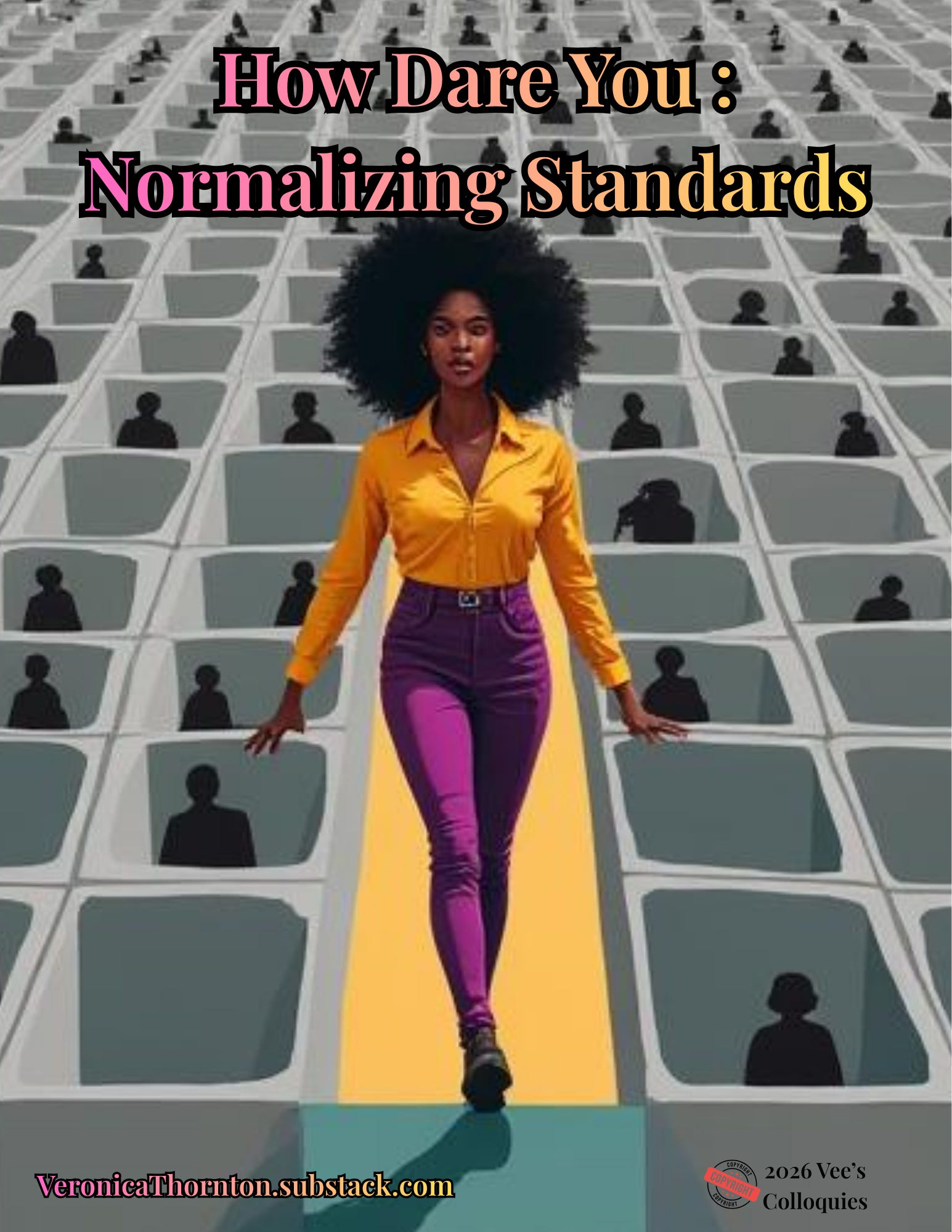
How Dare You
Normalizing Standards

I remember someone saying, “They won’t know what to do with you.”
All I could think was, then I better figure out what to do with myself. Why would I wait on someone else to decide? I don’t know what they would want to do with me. And I’m not sure they’ve earned the right to find out. But it makes me wonder if my insistence on being responsible for my own decisions baffles some people.
There really are people who believe they have this thing called life all figured out. They are so sure of themselves and what they intend to do about any and everything. Funny thing is, these are usually the same people who don’t handle disruption well. Anything that knocks them off their path breaks them down into smaller versions of themselves. Then they turn around and get upset with the people who chose not to go the same route.
Truth is, some people just allow life to show them what to create. Or they choose what to create. We make these choices along the way, and eventually we all have to decide: are we betting on ourselves, or are we waiting on someone else to figure it out for us?
There will always be people who think they know what kind of person you are based on their education, their training about people, places, things, and behaviors. They truly believe no one else could be analyzing the same situation, thinking just as deeply, and arriving at a different outcome. If you’re not doing it like them, you must not be doing it at all. Or you’re doing it wrong. But I keep wondering, what makes you so sure you’re doing it right? We do not experience the world the same.
Whose Standards?
I cringe every time I hear someone say something is or isn’t normal. My question is always the same: based on whose standards?
That’s the question people forget to ask. Because once you know whose standards you’re being measured against, you start to think a little differently. You begin to see that standards vary by culture and by place. And you have to reconcile with the fact that many of the standards we’ve normalized were built for someone’s benefit at another person’s detriment. That was the original systemic oppression.
Take the business suit. Historically, the suit served as visual shorthand for social class, separating the working class from the wealthy elite. By the twentieth century, the “power suit” defined professional status. Custom tailoring, fine wool and silk, precise cuts, all of it signaling disposable income and executive authority. And that expectation belonged only to men. Women were expected to wear skirts, dresses, and heels, and only in administrative or domesticated professions. That was something normalized until it became a standard.
Because I sit at an intersection of inequities, I see normal a little differently. The standards that got normalized do not fit anything within my being. So I will probably never be considered standard. Or normal. I’ve made my peace with that. The question is whether the standard ever deserved my aspiration in the first place.
Falling in Line
One day I decided to do something different. I decided to think for myself and take action. I decided I wanted more than what was being expected of me out of life. I decided that instead of letting others figure out what to do with me, I would figure it out for myself. Besides, no one was coming to save me but me. People have proven that. I cannot depend on other people to give me a sense of purpose.
But then I remember there are people who choose never to do anything different. Or they tried it once, it didn’t work out how they hoped, so they never tried being different again. This is who they are, this is what they were told, and this is what they choose to acknowledge. Falling in line with everyone else doesn’t make them the standard. It doesn’t make any of it normal, either. It just normalizes consistent behavior among many. And I understand the appeal. Without preset standards of behavior, there’s no reference point for what to expect from each other. Standards give us something to hold onto. The trouble starts when we forget we’re the ones holding them, and start believing they’re holding us.
And nowhere is this contradiction louder than in how America decides who gets to be more than one thing. Our culture worships celebrities. People chase fame and notoriety, and once someone is deemed notable for their craft, we celebrate their range. Oh, they’re so talented. Multi-hyphenate. Multifaceted. But if you’re still deemed average? Then you’d better fit into your assigned category so people will “know what to do with you.” You can’t do too much. Focus on one thing. Perfect it before you dare move on to anything else. The same range we applaud in the famous, we punish in the ordinary.
Who Gets to Tell It
Only in American culture do we acknowledge just the history deemed acceptable by white men of European descent. Other cultures tell full histories, as fully as their traditions of storytelling and preservation allow. The good, the bad, and the ugly. They understand there are lessons we’re supposed to carry from these stories as time goes on.
In American culture, the story must be controlled by the ones who have done the most damage historically. So we get a small piece of this country’s history. All the contributions made by people from cultures all over this nation, and what we receive is “a standard version.” Something everyone accepted and normalized that excluded most contributions from other cultures.
When people other than white men tell their version of history, it includes how white men tried to suppress or erase their cultures. Everyone experienced forced assimilation, because keeping your culture made you different, and different meant you were no longer the standard of anything. Standards in America were based on your level of whiteness or your proximity to it. From hair and makeup to which colors you could wear together, every measure of a person was normalized against white standards, all the way down to body language.
So how dare you disrupt American culture with truths inherently different from the ones permitted? How dare you still hold the wisdom of your ancestors and the stories their souls once carried. How dare you refuse to check the boxes I was told you should fit in. How dare you create new categories beyond the ones we call the standard. How dare you deny everyone else the pleasure of figuring out what to do with you? Who told you the choice was yours? You are not included in the history we want to tell.
That is everything they never say out loud. And still, I keep making the choice to be myself anyway. They say I’m different, but I keep asking: based on whose standards?
Vee